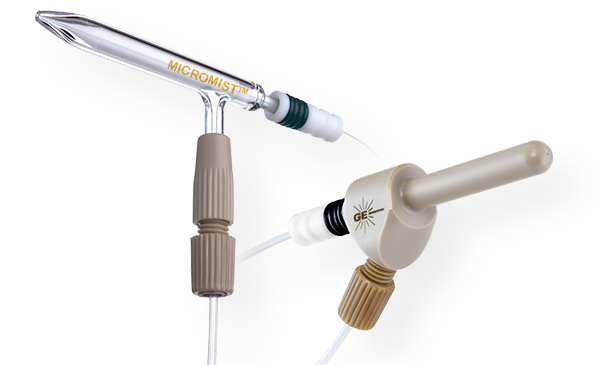
Aqueous Solutions without HF for ICP-OES
Aqueous Solutions without HF for ICP-OES▼
Limited Volume?
- Yes▼
-
No▼
High TDS? >5%
-
Yes▼
Particulates? >200µm
- Yes▼
-
No▼
Requirement?
- Best Sensitivity▼
- High TDS Tolerance▼
-
No▼
Particulates? >200µm
- Yes▼
-
No▼
Requirement?
- Best Performance▼
- Routine Operation▼
-
Yes▼
Particulates? >200µm
Aqueous Solutions without HF for ICP-MS
Aqueous Solutions without HF for ICP-MS▼
Limited Volume?
- Yes▼
-
No▼
High TDS? >5%
-
Yes▼
Particulates? >200µm
- Yes▼
- No▼
-
No▼
Particulates? >200µm
- Yes▼
-
No▼
Requirement?
- Best Performance▼
- Low-Level Boron▼
-
Highest
Purity▼
-
Yes▼
Particulates? >200µm
Solutions Containg HF
Solutions Containg HF▼
HF Concentration >5?
- Yes▼
-
No▼
High TDS? >5%
-
Yes▼
Particulates? >200µm
- Yes▼
- No▼
-
No▼
Particulates? >200µm
- Yes▼
-
No▼
Requirement?
-
Highest
Purity▼ - Best Performance▼
-
Highest
-
Yes▼
Particulates? >200µm
Organic Solutions
Organic Solutions▼
Volatile Solvent?
- Yes▼
-
No▼
Particulates? >200µm
- Yes▼
- No▼
Glass Expansion Nebulizers
The Global Standard in Nebulizer Innovation
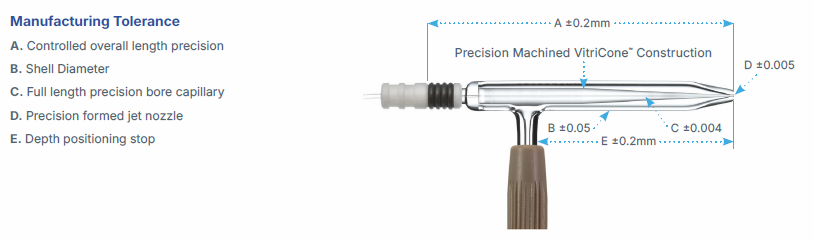
The nebulizer is a critical component of your ICP sample introduction system, so why not opt for the highest quality? Glass Expansion has been manufacturing ICP nebulizers since the early 1980s, and no other manufacturer can match the precision and reproducibility of our trademark VitriCone construction. We are so confident in our manufacturing capabilities that we showcase them for all to see.
All ICP Nebulizers are NOT created equal
Only Glass Expansion nebulizers include the unique VitriCone construction.
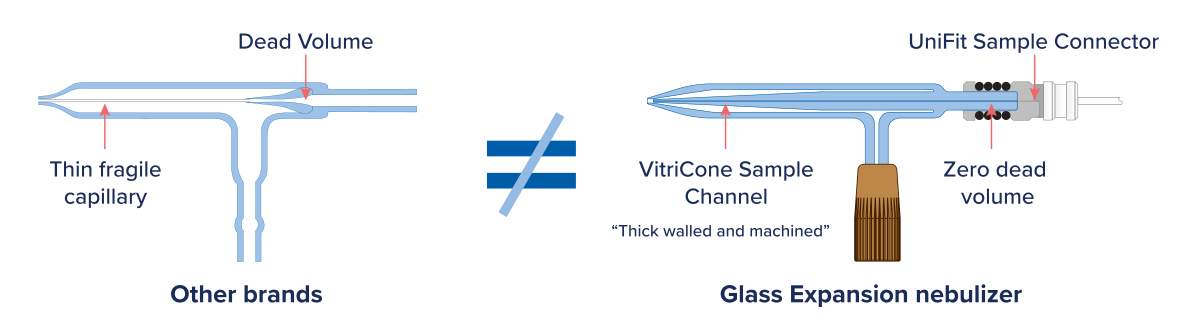
With some brands of glass concentric nebulizers, the sample channel is constructed from drawn-out capillary tubing. The problems with this type of construction are:
- The tapered tube geometry promotes clogging as the tube narrows.
- The tubing is fragile and more easily damaged.
- The tubing can vibrate under the influence of the high speed argon, leading to poor precision.
- Reproducible performance across different nebulizers is difficult to achieve.
All Glass Expansion concentric glass nebulizers use the unique VitriCone construction for the sample channel. With the VitriCone design, the sample channel is formed from heavy wall, precision bore glass which is machined to very high tolerances. The benefits of the VitriCone construction are:
- The sample channel's guaranteed uniformity makes it resistant to clogging.
- The rugged precision machined capillary resists vibration and delivers optimal precision.
- Industry leading manufacturing tolerances ensure uniform, high performance across all nebulizers.
Direct Connection (DC) glass concentric, DuraMist, OpalMist, and VeeSpray nebulizers
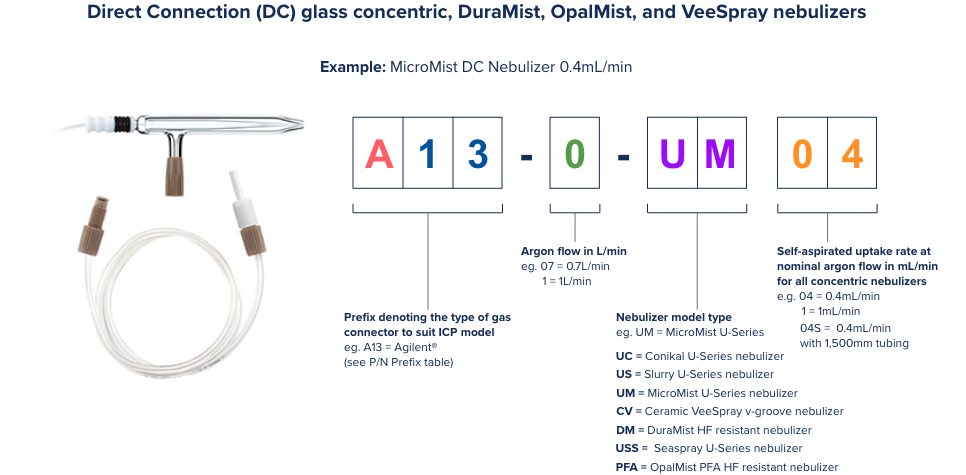
Note: All GE nebulizers (with the exception of the Veespray) will self-aspirate at the quoted flow rate, but all can also be pumped (peristaltic pump or syringe drive) at a flow rate equal to or less than the self-aspiration rate. For example, a 2.0mL/min nebulizer can also be pumped at 1.0mL/min.
Direct Connection (DC) Nebulizer Part Number Prefix
| Manufacturer | Model | Nebulizer P/N Prefix (Axx) | Gas Line |
| Agilent Technologies® | 4100, 4200 | MP11- | 70-803-0969 |
| Agilent Technologies® | 5100, 5110, 5800, 5900 | A13- | 70-803-1105 |
| Agilent Technologies® | Vista, 700-ES | A11- | 70-803-0969 |
| Agilent Technologies® | 7700, 7800, 7900, 8800, 8900 | A13- | 70-803-1105 |
| Analytik Jena® | ICP-MS | A61- | 70-803-2002 |
| Analytik Jena® | ICP-OES | A13- | 70-803-1105 |
| Horiba® Jobin Yvon | All Models | A13- | 70-803-1105 |
| Nu Instruments® | ICP-MS | A51- | 70-803-1858 |
| Nu Instruments® | TOF-ICP-MS | A52- | 70-803-2044 |
| PerkinElmer® | Optima, PE Avio | A21- | 70-803-1070 |
| PerkinElmer® | NexION 1000, 1100, 2000, 2200, 5000 | A23- | 70-803-1449 |
| PerkinElmer® | Elan/NexION 300/350 | A22- | 70-803-1049 |
| Shimadzu® | All Models | A41- | 70-803-1311 |
| Spectro™ |
All Models | A21- | 70-803-1070 |
| Thermo Scientific™ | PRO, 6000/7000, Q/RQ/TQ, X-Series & Neoma |
A31- | 70-803-1105 |
| Thermo Scientific™ | MX Series |
A13- | 70-803-1105 |
| Thermo Scientific™ | Neptune | A11- | 70-803-0969 |
U-Series glass concentric, DuraMist, OpalMist, and VeeSpray nebulizers
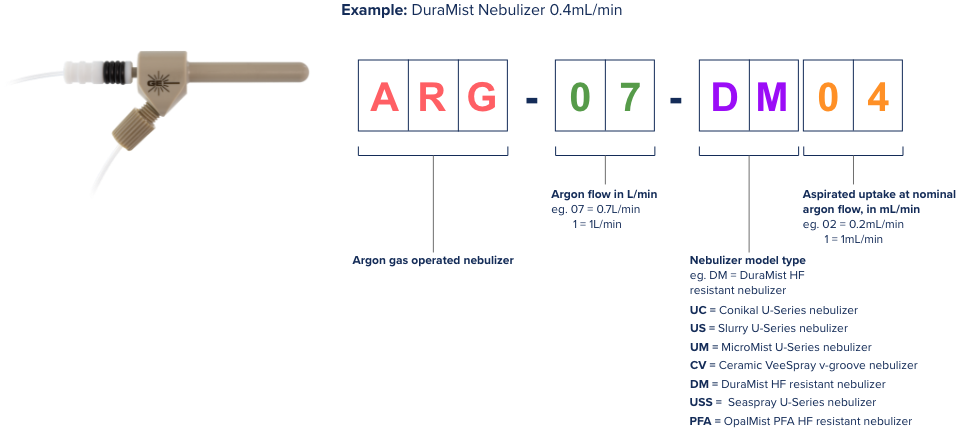
Note: All GE nebulizers (with the exception of the Veespray) will self-aspirate at the quoted flow rate, but all can also be pumped (peristaltic pump or syringe drive) at a flow rate equal to or less than the self-aspiration rate. For example, a 2.0mL/min nebulizer can also be pumped at 1.0mL/min.